
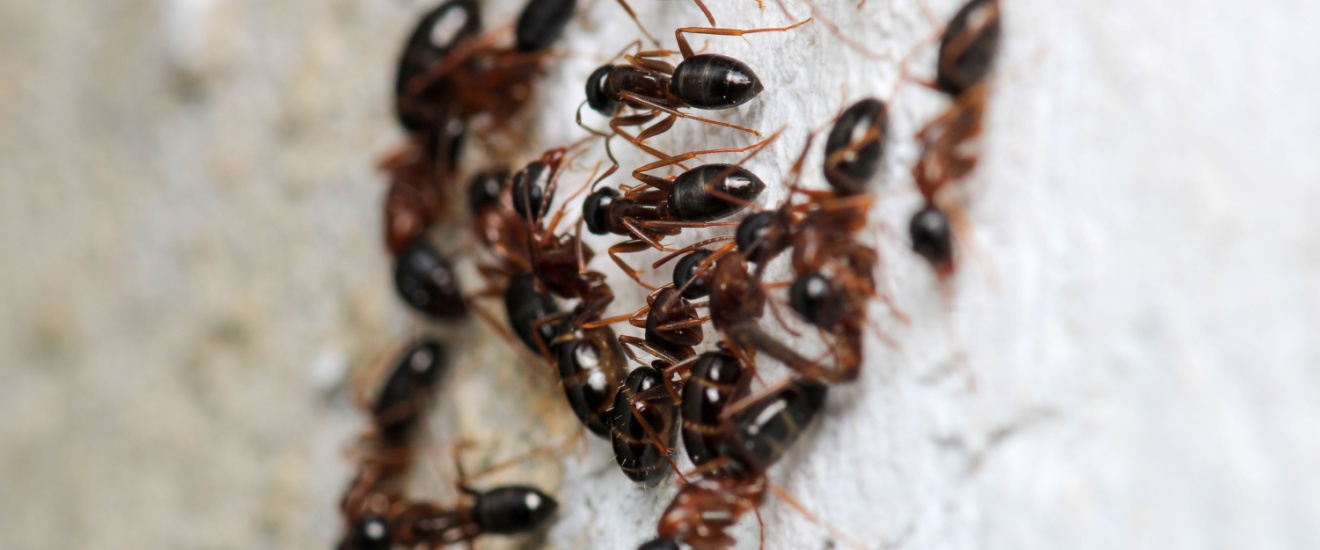
If ants have taken over your Elgin home—trailing across the kitchen counter, lining up along the bathroom sink, appearing in rooms where there is no obvious food source—there is a reason it is happening, and it starts with what is going on outside your home. A colony near your home has identified your house as a reliable source of food, water, or shelter, and it is sending foragers inside through entry points you may not even know exist. In southwest Oklahoma, the conditions that drive ant activity into homes are present for most of the year, which is why ant problems here tend to be persistent rather than occasional.
The Colony Is Close
Every ant trail inside your Elgin home originates from a colony living in the soil near your foundation, under your driveway, inside landscape mulch, or—in the case of carpenter ants—inside moisture-damaged wood on the structure itself. The ants you see on the counter are foragers. They represent a small fraction of a colony that may number in the tens of thousands. The queen, the brood, and the majority of workers are outside, producing new foragers faster than you can spray the ones inside.
In Elgin, where homes are surrounded by red clay soil that retains moisture after every rain, the conditions for ant nesting near foundations are favorable for most of the year. Irrigated lawns and planting beds add additional moisture to the soil around the perimeter. Concrete driveways, walkways, and patios provide warmth and shelter for pavement ant colonies underneath. The colonies are right there—often within a few feet of the nearest entry point into your home.
What Triggers the Surge
Ant activity inside Elgin homes spikes in response to specific environmental conditions:
- Heat: When summer temperatures climb into the upper 90s and above 100 degrees—which happens routinely from June through September in southwest Oklahoma—the ground surface becomes inhospitable for foraging. Colonies send workers into cooler, moister environments, and your air-conditioned home with its plumbing and condensation is the best option available. Kitchen sinks, bathroom faucets, dishwashers, and pet water bowls become primary targets.
- Rain events: Oklahoma thunderstorms saturate the soil and flood shallow ant tunnel networks. Colonies evacuate to higher ground—and when the nest is adjacent to your foundation, the nearest high ground is inside your home. The sudden ant trail that appears within 24 to 48 hours of a heavy rain is one of the most common pest encounters in southwest Oklahoma.
- Seasonal expansion: As soil temperatures warm in spring—typically March through May—ant colonies that slowed during winter enter their growth phase. Worker production increases. The foraging range extends. The colony’s territory expands into new areas, and your foundation is in the path. This is why many Elgin homeowners see the first significant ant activity of the year in April and May.
- Drought stress: Extended dry periods between rain events deplete outdoor moisture sources. Ants that were finding adequate water in the soil begin seeking it inside homes instead. This is why ant trails in the Elgin area often lead to sinks and faucets rather than food—the ants are after water, not crumbs.
Which Ants Are You Seeing?
The species matters because the treatment strategy depends on it.
Small, dark ants trailing in organized lines along counters and baseboards—most likely odorous house ants or pavement ants. These are the most common indoor-trailing species in the Elgin area. Odorous house ants nest in moist soil near foundations and inside wall voids. Pavement ants nest under concrete driveways, walkways, patios, and slabs.
Large, dark ants seen individually or in small numbers, particularly at night—possibly carpenter ants. If you are also finding small piles of sawdust-like shavings (frass) near wood trim, window frames, or door frames, a carpenter ant colony may be excavating inside the structure. This species causes progressive wood damage and should be addressed by a professional promptly.
Reddish-brown ants with visible mounds in the yard—fire ants. While primarily an outdoor pest, fire ants can and do enter homes through foundation cracks, expansion joints, and gaps around utility penetrations. Their stings are painful and can cause serious reactions, particularly in children and pets.
Why Cleaning and Spraying Are Not Enough
Wiping the trail removes the visible ants and temporarily disrupts the pheromone signal. But the colony is intact. The queen is still producing workers. And the pheromone residue—even after cleaning—is often strong enough for new foragers to rediscover the same path within hours.
Consumer repellent sprays create additional problems. When ants encounter a repellent chemical, they do not walk through it and die. They detect the residue and reroute, finding alternative entry points into the home. With some species, repellent exposure causes the colony to fragment and establish new nesting sites—turning one trail into multiple trails from multiple locations.
Professional ant control uses non-repellent products that foragers cannot detect. They walk through the treated zone, pick up the product, carry it back to the colony, and spread it through the population through contact and food sharing. Within one to three weeks, the product reaches the queen. The colony collapses from within—not because you killed the ants on the counter, but because those ants delivered the treatment to the source.
What Homeowners Can Do Between Treatments
- Fix dripping faucets and eliminate standing moisture inside the home—water is the primary attractant during hot, dry periods
- Store food in sealed containers and clean up crumbs and residue promptly
- Pull mulch back at least 12 inches from the foundation
- Seal visible cracks in the foundation, around window frames, and at utility penetrations
- Ensure the garage door seals flush against the concrete
- Trim vegetation so branches and shrubs do not contact the home exterior
These steps reduce the conditions attracting ants to the property. Professional treatment eliminates the colony and maintains the barrier that prevents recolonization.
If ants have become a persistent problem in your Elgin home, contact Boots Pest & Weed Control for a free quote and get treatment that targets the colony, not just the trail.